Reverse Osmosis Drinking Water Installation in Idaho Falls, Idaho
By Chad Baxter, Licensed Plumber · Water Softeners Plus LLC · Serving Idaho Falls, Ammon, Iona, Ucon & Surrounding Communities
Clean, bottled-quality drinking water straight from your kitchen tap — for pennies a gallon, with no plastic to haul home. $699 fully installed. A four-stage reverse osmosis system that removes approximately 98% of dissolved solids from your drinking water — including the calcium, magnesium, sodium, fluoride, and chlorine taste left in Idaho Falls' 14 GPG city water. Installed under your kitchen sink with a dedicated faucet on the countertop. No power required. No monthly subscription.
Idaho Falls' water is safe to drink straight from the tap — but it's also some of the hardest in the country at 14 grains per gallon. A water softener takes care of every appliance and shower in the house. Reverse osmosis takes care of the water you actually drink. Here's how RO works, what it costs to run, and when it makes sense as a standalone install versus part of a complete home system.
licensed plumber
removed
cost
life
Why Idaho Falls Drinking Water Benefits from RO
Idaho Falls draws its water from the Eastern Snake River Plain Aquifer — a vast underground system that runs beneath much of southern Idaho. As groundwater moves through the region's basalt rock and limestone formations on the way up to your tap, it picks up enormous amounts of dissolved calcium and magnesium. By the time it arrives at your kitchen sink, the City of Idaho Falls measures hardness at approximately 14 grains per gallon — over three times the threshold the Water Quality Association classifies as "very hard."
The water is safe. Idaho Falls' treatment plant disinfects with a small amount of chlorine and monitors for contaminants. What that process can't do is remove the dissolved minerals — that takes filtration at the home. And those minerals are what you taste in the water, what builds up on the inside of your kettle, what spots your ice cubes, and what gives Idaho Falls water its characteristically "heavy" feel.
Reverse osmosis is the only practical home technology that strips out dissolved solids. The system pushes water through a semipermeable membrane with pores small enough to block calcium, magnesium, sodium, fluoride, lead, arsenic, nitrates, and any leftover chlorine taste. What comes out the other side is essentially the same water that bottled-water companies sell — produced at your kitchen sink for pennies per gallon, with none of the plastic. Curious how fast that adds up? Our bottled water vs. RO savings calculator shows the payback for your household.
What's Included in the $699 Install
Equipment
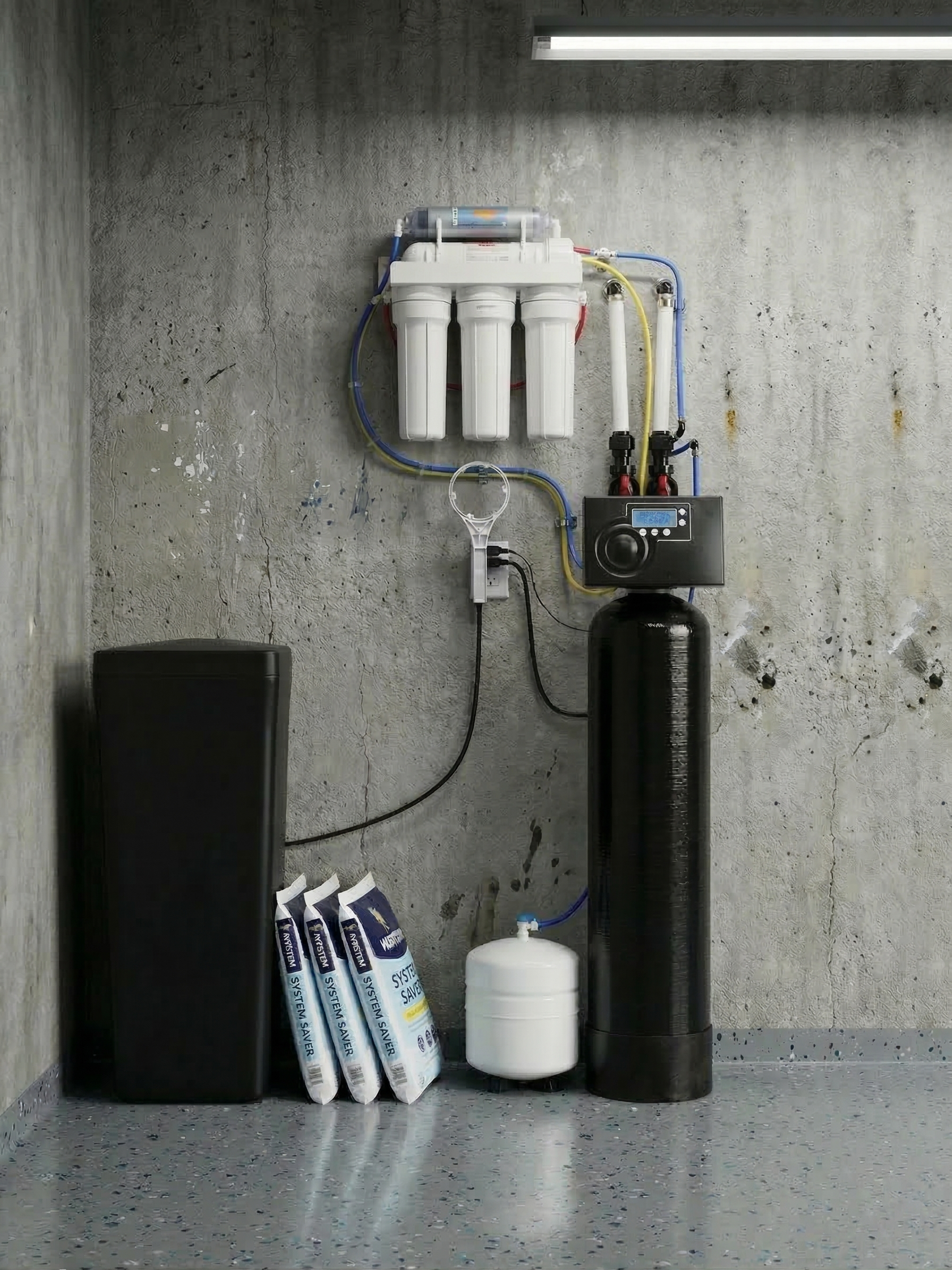
- ✓Four-stage RO unit (sediment, carbon pre-filter, RO membrane, polishing carbon post-filter)
- ✓3.2-gallon pressurized storage tank
- ✓Dedicated chrome RO faucet for the countertop
- ✓All tubing, fittings, and shut-off valves
- ✓Saddle valve drain connection to existing kitchen plumbing
- ✓First set of filters included
Labor
- ✓Plumbing tie-in under the kitchen sink to cold-water supply
- ✓Faucet hole drilled in countertop if needed (most kitchens already have a sprayer hole to use)
- ✓Drain saddle install on existing P-trap
- ✓System flush and water quality test after install
- ✓Walkthrough on filter change procedure
Optional add-ons
- +Premium faucet upgrade — $799 total install (vs. $699 standard). Brushed nickel, oil-rubbed bronze, and matte black available.
- +Refrigerator / ice-maker line — $125. Runs RO water to your fridge dispenser and ice maker.
- +Utility-room placement — $299. Installs the RO away from the kitchen sink so the drain trickle isn't in your kitchen (requires space and a nearby drain).
Standalone RO vs. RO Paired with a Softener
Reverse osmosis works as a standalone install. It's the right move if you're renting and can't modify the whole-house plumbing, if you're on a budget and want to fix the drinking water first, or if you're an Idaho Falls family that just doesn't love the taste of city water and isn't ready to commit to a full treatment system yet. $699 gets you clean drinking water at the kitchen sink and you're done.
That said — most Idaho Falls homes end up running both. Here's why: 14 GPG hardness wears the RO membrane down faster than it should, shortening its life from 5 years to about 3. The softener upstream protects the membrane and makes the whole system more efficient. And the softener takes care of everything the RO can't reach — the dishwasher, the water heater, the shower, the laundry, the ice maker. The combination is what we install most often in Idaho Falls because it's simply the right tool for the water here.
A common worry from softener owners: "am I drinking sodium?" The answer is yes, in trace amounts — a softener replaces calcium and magnesium with a tiny bit of sodium through ion exchange. For most people it's negligible. But if you're sodium-sensitive, or you just don't love the idea, an RO system at the kitchen tap removes that sodium completely. Soft water everywhere else. Zero-sodium drinking water where you drink. That's the main reason softener + RO is the gold standard for Idaho Falls homes.
Most Idaho Falls customers we install RO for end up adding a softener within a year or two. If you know you want both, our packages save you real money versus paying for them separately:
- City Water Package — $2,699 installed. NuGen Fusion XT softener + whole-house carbon filter. Save $199.
- Complete Home Package — $3,299 installed. Softener + carbon filter + reverse osmosis at the kitchen tap. Every drop of water in your house, treated. Save $298 versus a la carte.
Maintenance and Ongoing Cost
RO systems are simple to live with. The four-stage unit has three filter cartridges that get changed annually — sediment, carbon pre, and carbon post — and the RO membrane itself gets changed every 3 to 5 years. Total cost in filters is around $80 a year. The annual swap is a 15-minute DIY job for most folks, or we'll come out and do it on a service call.
There's no subscription, no monitoring fee, no contract. You own the system outright. The only ongoing cost is the filters and the small amount of water used to flush the membrane during normal operation. RO units produce roughly 1 gallon of drinking water for every 3 to 4 gallons used — that ratio improves dramatically when a softener is installed upstream because the membrane works less hard.
Specs and Configuration
| Dissolved solids reduction | ~98% |
|---|---|
| Stages | Sediment, carbon pre-filter, RO membrane, polishing carbon post-filter |
| Daily production | ~50 gallons per day at 60 psi |
| Storage tank | 3.2-gallon pressurized holding tank |
| Faucet | Standard chrome faucet included; premium faucet upgrade $799 total install |
| Fridge / ice maker line | $125 add-on at install |
| Utility-room placement | $299 add-on (space + nearby drain required) |
| Filter change interval | Annual (~$80 in filters, DIY or service call) |
| Membrane life | 3 years on raw 14 GPG city water; 5+ years with a softener upstream |
| Drain connection | Saddle valve to existing kitchen drain line |
| Power required | None |
| Footprint | Fits under most standard 36" kitchen sink cabinets |
Reverse osmosis is a point-of-use system at the kitchen sink. It doesn't soften the water going to your dishwasher, your shower, your laundry, or your hot water heater — for that, you need a whole-house water softener. RO also produces a small amount of waste water during normal filtration, which is unavoidable with any membrane-based system. And like any filter, it has limits: it's not designed for water of unknown microbiological quality. Idaho Falls city water is fine; well water with bacteria risk should be treated upstream with UV or chlorination before the RO.
Service Area — Idaho Falls and Beyond
Water Softeners Plus installs reverse osmosis systems throughout Idaho Falls — including the West Side, Numbered Streets, Sunnyside, and Lincoln Park — plus Ammon, Iona, Ucon, Rigby, Ririe, Sugar City, St Anthony, Rexburg, Shelley, Blackfoot, Pocatello, Driggs, and Victor. Same $699 price across the entire 100-mile service area; no surcharge for the drive. Most Idaho Falls installs can be scheduled within the week.
Free In-Home Water Test — No Obligation
Before recommending an RO system, we test your Idaho Falls water and tell you exactly what's in it. If RO is the right call, we'll explain why. If a softener should come first, we'll say that too. No sales pitch, no pressure.
Frequently Asked Questions
Idaho Falls treats its water for microbial safety — chlorination, monitoring, all the things a municipal supply does. What it can't do is remove the calcium, magnesium, and other dissolved solids that make Idaho Falls water 14 grains per gallon. RO is the only practical home filtration that strips out those dissolved minerals along with fluoride, lead, sodium, and the lingering chlorine taste. It's the finishing layer for the water you actually drink and cook with.
Yes. Plenty of Idaho Falls households install RO by itself — especially if you're renting, on a budget, or only worried about drinking water quality. At $699 installed, RO is a complete standalone solution for what you drink. It just won't help your dishwasher, your shower, your laundry, or your water heater — those still see Idaho Falls' 14 GPG hard water until a softener goes in.
Yes, in trace amounts. Softeners replace calcium and magnesium with a small amount of sodium through ion exchange. For most people the amount is negligible — about the same as a slice of bread per gallon. But if you're on a sodium-restricted diet, or you just don't love the idea, an RO system at the kitchen tap removes that sodium completely. Soft water everywhere else in the house, zero-sodium drinking water where you drink. That's why softener + RO is the gold-standard setup we install most often in Idaho Falls.
The RO system installs under your kitchen sink and feeds a small dedicated faucet on the countertop, usually next to your main sink faucet. Your main faucet keeps running softened or city water for dishes and rinsing; the RO faucet gives you purified water for drinking, cooking, ice makers, coffee, and houseplants. We can also plumb a line to your refrigerator's water dispenser and ice maker for a $125 add-on, so the whole kitchen runs on RO.
That's normal, and it's not a leak. It's your RO system sending concentrate water to the drain while the storage tank refills — the membrane flushes the dissolved solids it just filtered out down the drain instead of into your glass. If your household drinks a lot of RO water, the tank refills often, so you may hear a faint, near-constant trickle at the sink drain. If that sound bothers you, we can install the RO in a utility room instead of under the kitchen sink — wherever there's space and a nearby drain — for a $299 add-on, which moves the trickle out of your kitchen entirely. Since your softener and carbon filter already live in the utility room, many customers who go this route choose the Complete Home Package and have all their water treatment installed together in one spot.
Filter changes once a year, membrane replacement every three to five years. The annual filter swap is a 15-minute DIY job for most folks — we sell the filter sets and walk you through it, or we'll come out and do it on a service call. No subscription, no surprise fees. Total ongoing cost is around $80 a year in filters for the typical Idaho Falls household.
It accelerates wear, yes. Calcium and magnesium build up on the membrane surface and gradually reduce its effective life. With Idaho Falls' 14 GPG hardness, a membrane on raw city water typically lasts 3 years; with a softener upstream, you can stretch that to 5+ years. The softener also makes the RO system more efficient (less waste water, faster recovery). That's the main reason we usually recommend the City Water Package or Complete Home Package for Idaho Falls.
Yes. We install reverse osmosis systems throughout Idaho Falls — the West Side, Numbered Streets, Sunnyside, Lincoln Park — plus Ammon, Iona, Ucon, Rigby, Ririe, Sugar City, and St Anthony. Same $699 price across the entire 100-mile service area. Most installs in Idaho Falls can be scheduled within the week.
There's a popular myth that RO water is unhealthy because it strips minerals. The reality is that we get almost all of our dietary minerals from food, not water — a single serving of leafy greens has more calcium than gallons of even the hardest tap water. RO water is essentially the same water bottled-water companies sell at $2 a bottle, produced at your kitchen sink for pennies per gallon. If you'd like minerals added back for taste, there are remineralization filters that bolt onto the system — ask about it during your free water test.